What we know about human development

Spain richest empire on earth 450 years
450 years
~1500s · Empire peak 1964 · Developed
Korea $1,038 per capita 35 years
35 yrs
1953 · Education decision 1987 · Developed

Spain had wealth. Korea chose education.
What separated them was what each country loaded into its children's eighteen years.

185 countries · 140 years of data

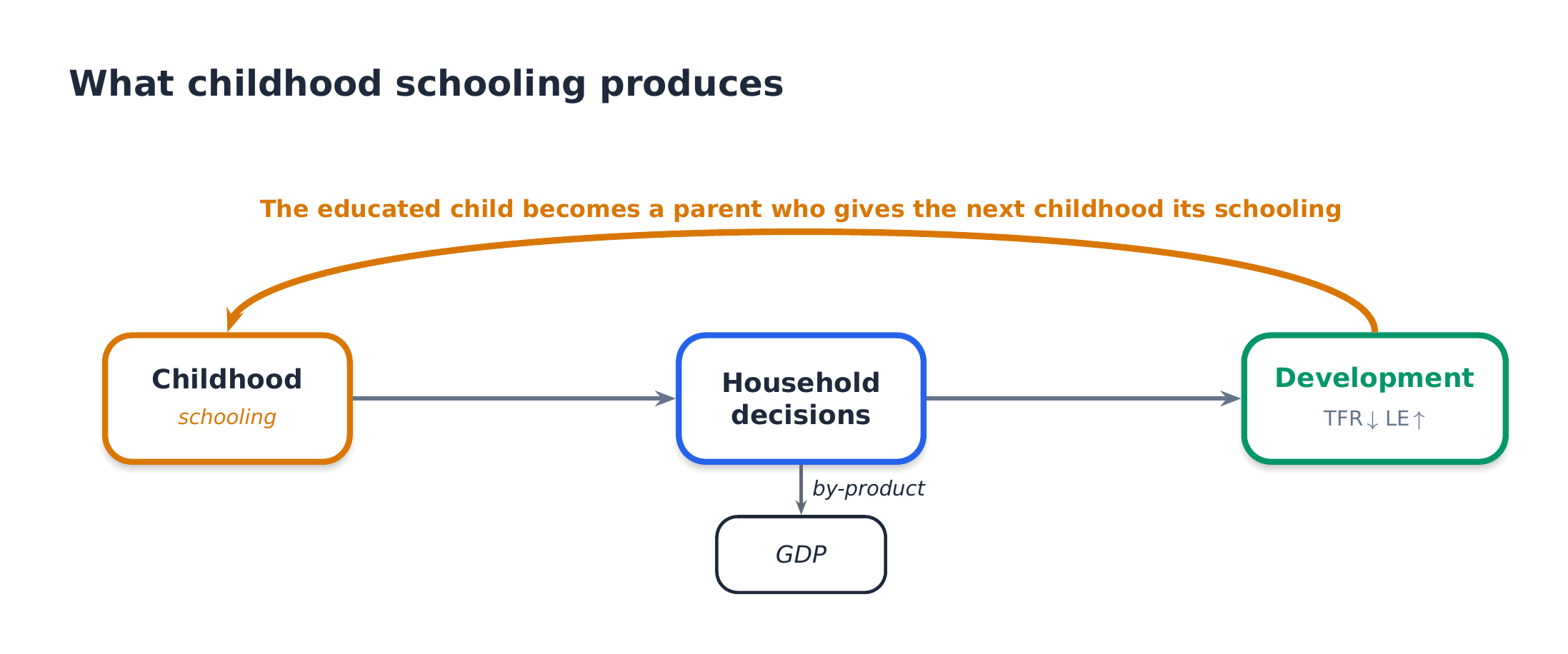
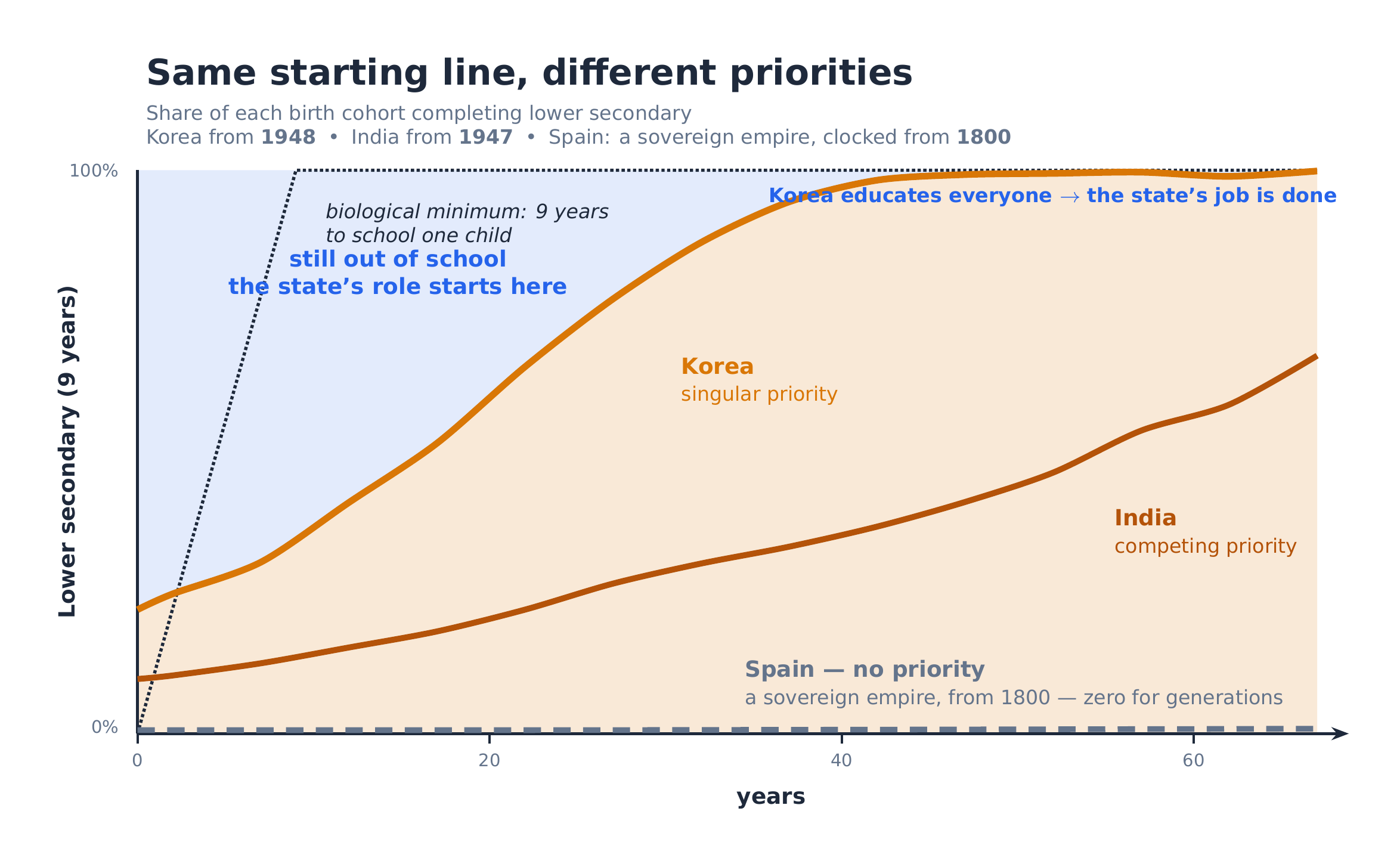
What childhood schooling produces: schooling in childhood produces the household decisions educated adults make, which lower fertility and raise life expectancy; the educated child grows up to be a parent who gives the next childhood its schooling; GDP is a by-product. The same window loaded at different speeds: under singular priority Korea reaches near-universal lower-secondary completion within a generation; under competing priorities India climbs slowly; Spain, a sovereign power that did not prioritise, sits at zero across the nineteenth century.

The whole story in one path. The state paces how fast schooling reaches each family; everything downstream — the household decisions educated adults make, the fall in fertility and the rise in life expectancy — is what childhood schooling produces. The educated child grows up to be a parent who gives the next childhood its schooling, and the ratchet turns once a generation. Income is a by-product of the same educated population, not a separate channel.

The world today

It already happened for 80% of humanity

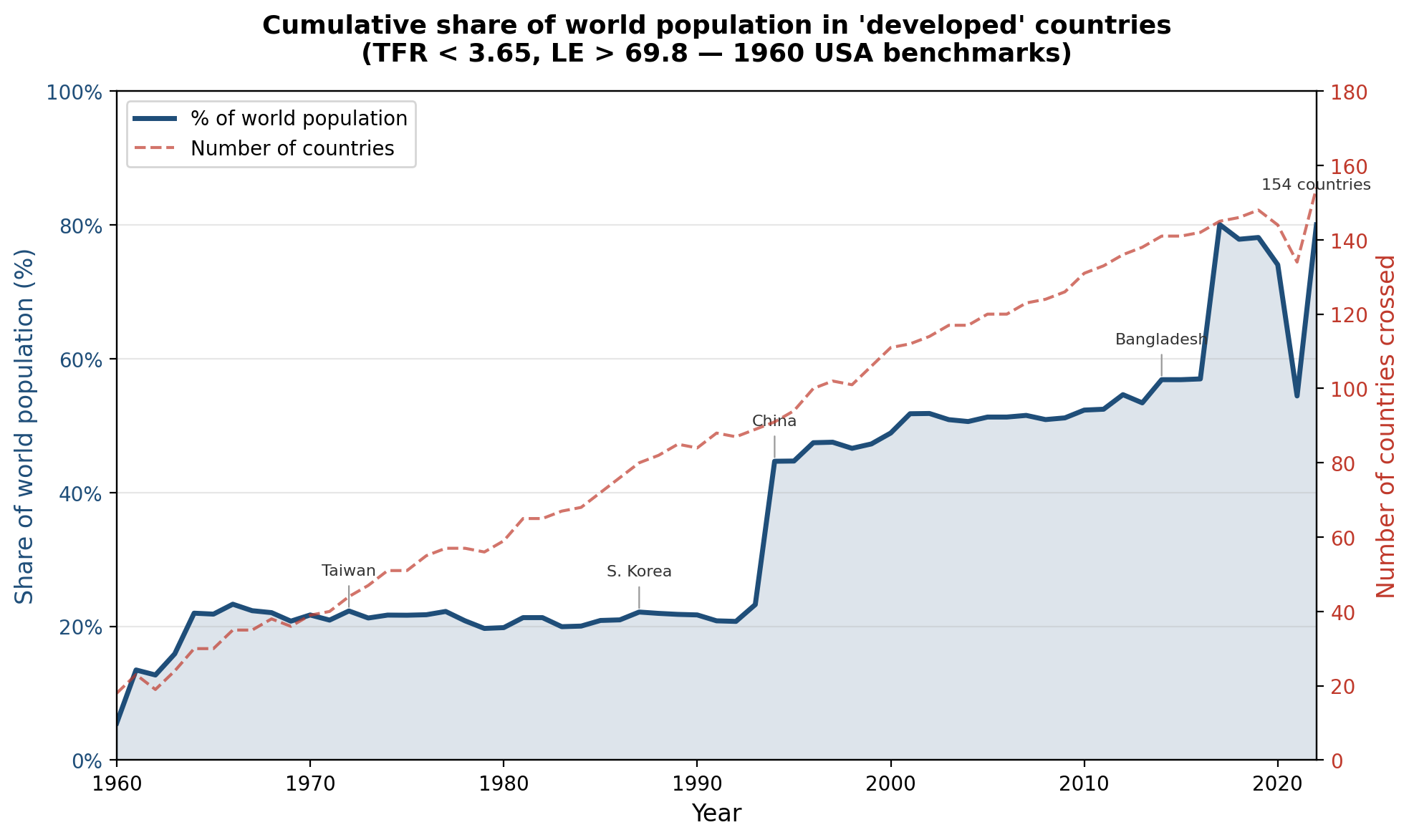
154 countries now have fewer children per woman and longer lives than the United States had in 1960. This is not a theory. It is an accomplished fact.

80%
of humanity has crossed
154
countries developed
20%
remaining — mostly sub-Saharan Africa, plus Pakistan, Afghanistan, Yemen
Cumulative share of world population in developed countries (fewer than 3.65 children per woman, life expectancy above 69.8 — 1960 USA benchmarks)

This takes the Human Development Index as its inspiration: education, both means and end — but development is measured by what it delivers, long lives and chosen family size. The slow climb from 1960 to 1993 is countries expanding education gradually. The vertical jump in 1994 is China — which reached both benchmarks after three decades of educational expansion. By 2001, half of humanity had crossed. The remaining 20% is concentrated in sub-Saharan Africa, with Pakistan, Afghanistan, and Yemen as the largest exceptions.

What carries it forward

Education carries development — income is what it produces

Income looks like it predicts development because education drives income. Strip out education's contribution, and what's left of income predicts almost nothing — on every outcome.

Take each country's income, remove the part that education explains, and use what remains to predict outcomes 28 years later. What remains predicts almost nothing. The signal that looked like income was education moving through it.

What predicts development one generation forward?
How much of the variation does each explain? (Income measured after removing education's contribution)
Life
expectancy
48%
Education
0.1%
Income
Children
per woman
47%
Education
0.1%
Income
Child
education
51%
Education
0.4%
Income
Child
survival
26%
Education
0.5%
Income

Each country compared only to its own past, 130+ countries, 1960–2015. Income measured after removing education's contribution.
Income's numbers are so small they could be zero — no meaningful predictive power.

These numbers come from comparing each country to itself over time — not comparing rich countries to poor ones. The method controls for everything permanent about a country: its geography, culture, colonial history, institutions. What's left is change over time. And the change is driven by education.

The part of income that has nothing to do with education explains under 2% of variation on every development outcome — life expectancy, fertility, the next generation's education, child survival. Income is downstream. Education is the cause.

This holds at every education level (primary, lower secondary, upper secondary), every time lag (15 to 30 years), and with girls' education specifically. Educated mothers are even stronger predictors than the population average — the mechanism runs through families, not economies.

Here is the sharpest form of the same fact. If income bought education, the income a country needs to reach a given schooling level would be a stable price. It is not — it collapses. To school half a cohort through lower secondary, the income required has fallen severalfold in constant dollars since 1960, and that is against global growth, which should have pushed it up. Measured against each era's world-median income the fall is far steeper: a country at that schooling level has moved from well above the typical country's income to below it. Poorer and poorer countries reach the same schooling decade after decade — impossible if income were the gate. Schooling spreads down the income ladder like a technology, not a purchase, which is why Korea, Cuba, Bangladesh, and Sri Lanka schooled their children while still poor. You do not need to get rich first.
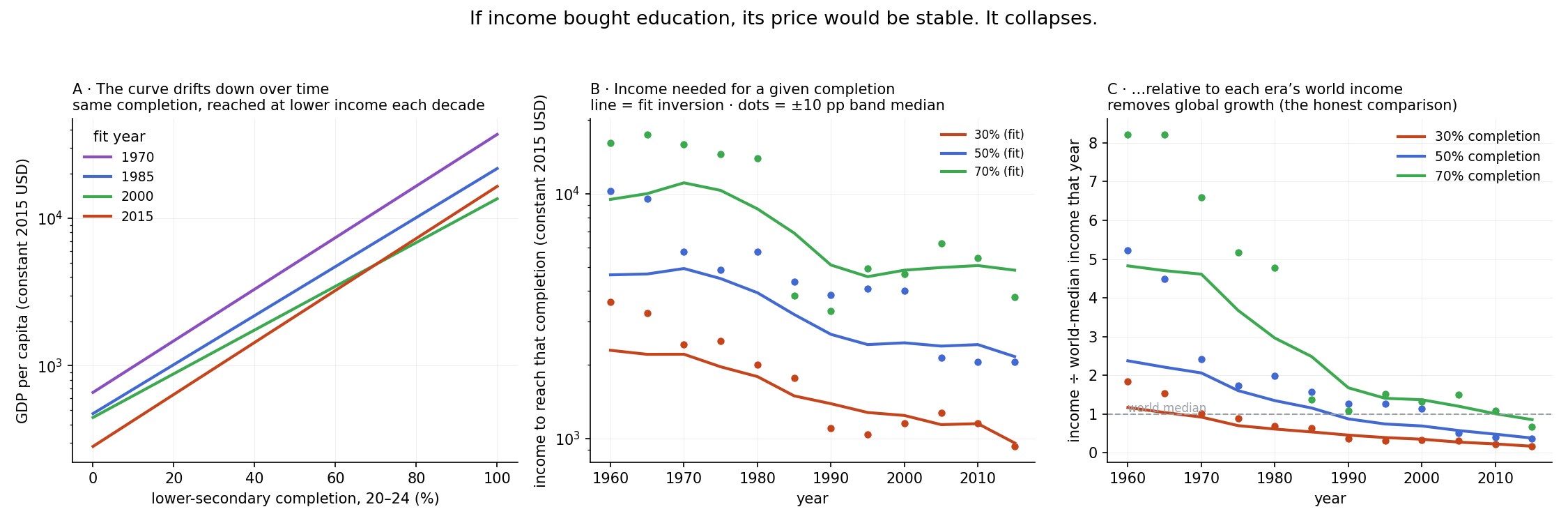
The income needed to reach a given lower-secondary completion level falls steeply over time — in absolute constant dollars and, far more, relative to each year's world-median income — shown by both a per-year fit inversion and a band median. If income bought education its price would be stable; instead it collapses.

The price of education in income, over time. If income bought schooling this would be flat; instead the income to reach any given completion level collapses — poorer countries school their children each decade. (Source: author's calculation, World Bank WDI and WCDE v3.)
How long it lasts

Education lasts for generations; income fades in one

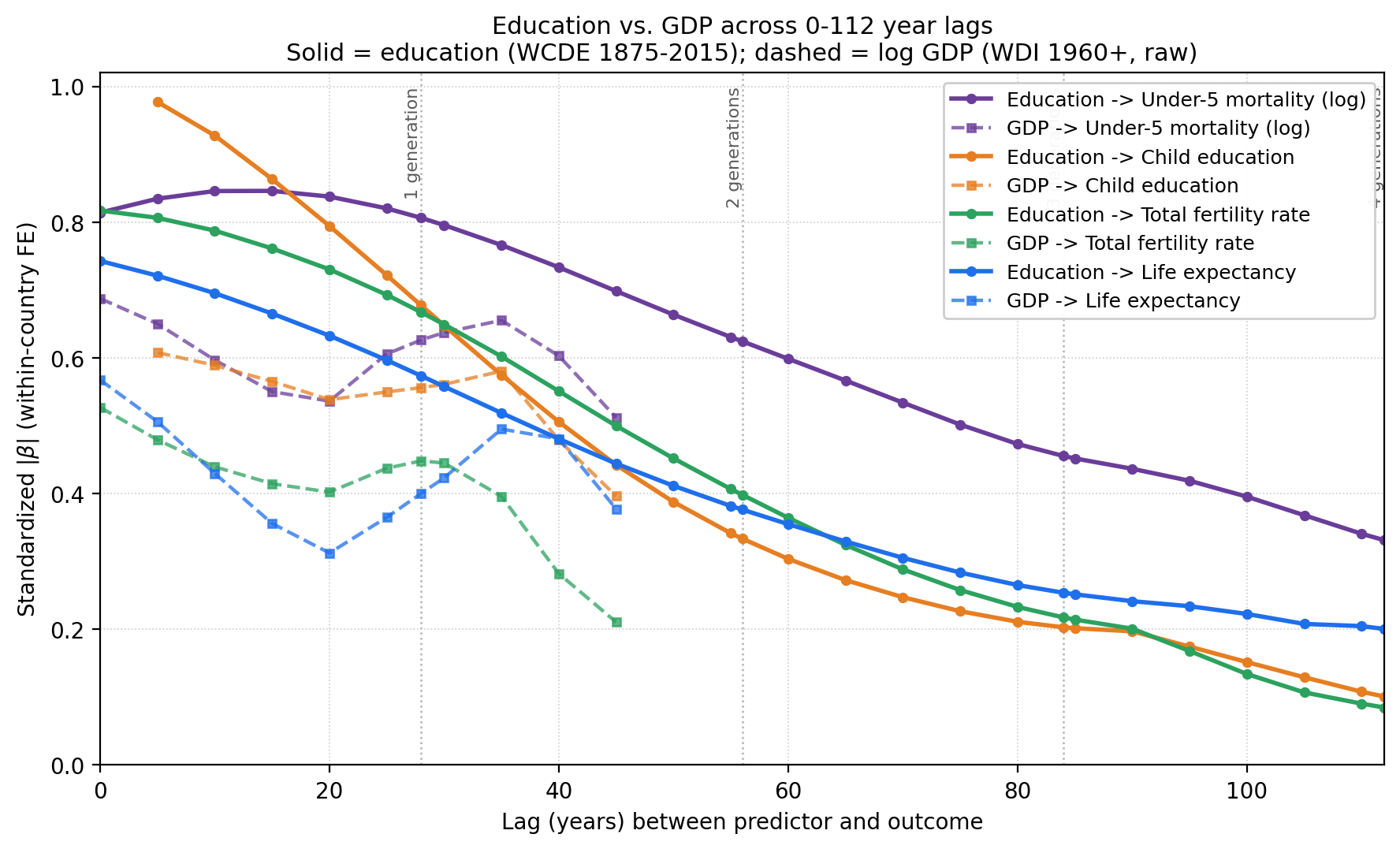
How far into the future does each variable predict? Education's signal persists across four generations — over a century. Income fades within one generation.

Education vs income predictive power across lag lengths, for life expectancy, fertility, child mortality, and child education. Education's signal persists across four generations (112 years); income's signal does not last beyond one generation.

The decay is smooth — not stepped at 28-year intervals — because real populations have continuous age structure. People are of all ages at all times. Education enters the population as successive cohorts complete schooling, and the household decisions that produce development outcomes are exercised by adults across their entire lifetimes. The smooth curve is the signature of a continuous generational process, not a discrete 28-year pulse.

Demographic metabolism is the technical name (Lutz 2013): the rate at which more-schooled cohorts displace less-schooled ones in the population, one generation per replacement. This is the slowest variable in the policy ledger. Every other lever a country has — institutions, markets, regulations, fiscal rules — runs faster than education can. None substitute for the cohort coming through school. That asymmetry is why education is the limiting factor on a country's developmental trajectory: get the rules wrong and you fix them next year; get the schooling decision wrong and you lose a generation.

Before about 1960, income did not vary much between countries — nearly everyone earned roughly $400–600 per person per year. There is no hidden income signal to find. But education did vary: some countries had been building schools for centuries. A great-great-grandparent's school completion in 1915 still predicts their great-great-grandchild's child-survival outcomes in 2015 — a century later, through three intervening households.

Income moves with life expectancy in the present but does not carry it forward. Education does — across a century and three intervening households.

Why it compounds

Education never goes backwards

In every country, in every period, children are at least as educated as their parents. The gains compound. They do not depreciate.

This is not a statistical pattern — it reflects biology. Humans have the longest childhood of any species: roughly 18 years of learning from parents. Educated parents transmit what they know to their children. That transmission is embedded in the parent-child relationship, not in government budgets or institutions. You cannot take it away by cutting a budget or collapsing an economy.

Among countries still expanding education, each generation doesn't just match the previous one — it exceeds it. Below 20% parental completion, each percentage point of parental education produces 2.9 percentage points in the next generation. The state adds reach beyond what households transmit alone.

Education amplifies across generations
Each point of parental education produces more than one point in the next generation (below ceiling)
Below 20% parental education 2.9× amplification Below 50% parental education 1.8× amplification Below 90% parental education 1.2× amplification Approaches 1.0 as countries reach near-universal education (ceiling effect) The mechanism hasn't weakened — the job is done.

Each generation does not merely match the one before — it exceeds it. The amplification factor is 2.9, not 1.0. The state, building schools on top of what parents already transmit, is what pushes it higher.

When income collapsed

Income wiped out, education untouched

The Asian Financial Crisis of 1997–98 wiped out income across five countries overnight. Education was untouched. It kept going.

Indonesia
−14.5%
income collapse
+5.4pp
education gain
Thailand
−8.8%
income collapse
+13.4pp
education gain (accelerated)
Malaysia
−9.6%
income collapse
+1.5pp
education gain (near ceiling)
Philippines
−3.0%
income collapse
+4.9pp
education gain
Korea
−5.6%
income collapse
+0.2pp
already at 99% (ceiling)

This is the cleanest income-removal test in the data. Income was abruptly wiped out — not gradually, not by policy choice. Education was untouched at every level: lower secondary, upper secondary, and college. Thailand actually accelerated through the crisis.

Why? Because education is embodied in people, not stored in budgets. An economic crisis can empty a bank account. It cannot un-educate a mother.

Take each piece away

Only one thing breaks everything

A true cause, removed, breaks the outcome. Everything that is not the cause can be taken away and development continues. Only one thing fails this.

Remove income

Still works
Bangladesh reached both benchmarks at $1,159 per person. Korea developed before it was rich. The Asian Financial Crisis wiped out income; education was untouched.

Remove government provision

Still works
Korea and Taiwan achieved development with minimal welfare states. The mechanism lives in households, not in state budgets.

Remove education

Everything breaks
Cambodia under the Khmer Rouge lost its educated population. It took a full generation to recover. South Africa under apartheid deliberately suppressed education for the majority — and development stalled for decades.

Remove security

Still works
Sri Lanka's 26-year civil war slowed but did not break the educational base. Myanmar's 73 years of military rule did not prevent development outcomes from improving on schedule.

The asymmetry is structural: income is stored in banks and can be wiped out. Government programmes depend on budgets and can be cut. Education is stored in people. You cannot take it away.

And where reported schooling once outran reality — the Soviet republics, which logged near-universal completion their populations never lived — fertility, the one number a pro-natalist state had no reason to fake, gives it away: Central Asian birth rates tracked Iran's and Turkey's for six decades. Full treatment in the paper →

The evidence is sufficient. The decision is necessary.