What Humans Are
Human childhood is the channel through which each generation transmits itself to the next. It has never been empty. Filling it with education is what makes a population developed. That is my argument.
Education is fundamental to human well-being. Not important — fundamental. The distinction matters. Important means high on a list. Fundamental means the list does not exist without it.
Education is the necessary and sufficient cause of human development. Necessary: no country has developed without it. Sufficient: educated people are developed — they live longer, have fewer children, make better health decisions, and transmit these gains to their children without requiring income or provision as intermediaries. Sufficient also because an educated population operates every other policy lever at policy speed — adopting new institutions, rewriting rules, taking up new technologies — while an uneducated population cannot, no matter how well-designed the rules. The institutions that carry longer lives and smaller families — a population's own health and schooling — are automatic once it is educated, under any political system. Markets are the exception: an educated population can build them, but political power can hold them below what the education would otherwise build.
The mechanism is the home niche: the parents, grandparents, older siblings, and near-kin embedded in a child's daily life across the roughly eighteen-year juvenile dependency window. An educated home niche transmits knowledge, norms, health behaviours, and the decision to educate the next child.
The state's role is not to make education work but to add a second niche — the school niche of teachers and schools — alongside the home niche, until enough households carry literate cultural transmission forward on their own. Without the state, the home niche preserves what exists but does not expand. All expansion is state expansion: across centuries with competing priorities, within a single generation with singular commitment.
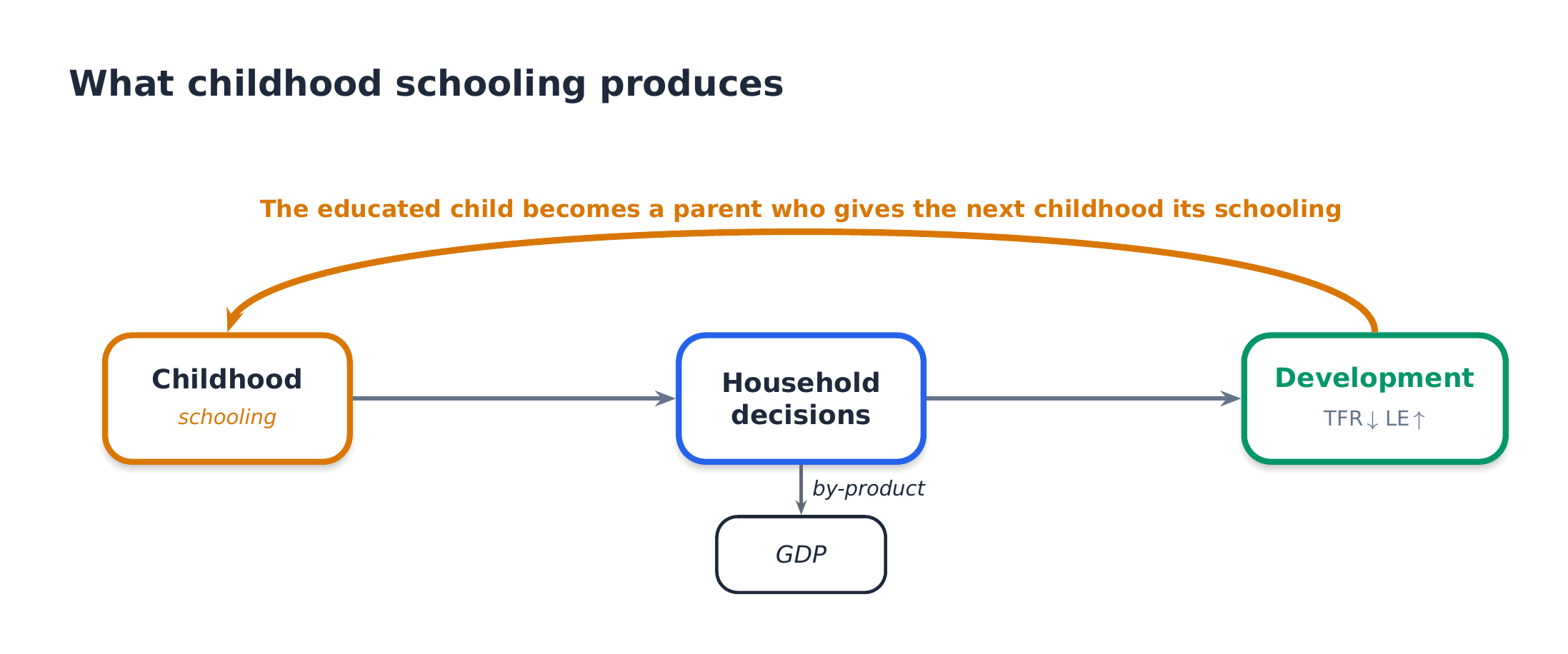
What childhood schooling produces. Everything downstream — the household decisions educated adults make, the fall in fertility and the rise in life expectancy — is what schooling the child produces. The educated child grows up to be a parent, and gives their own children the same schooling; the ratchet turns once a generation. Income is a by-product of the same educated population, not a separate channel.
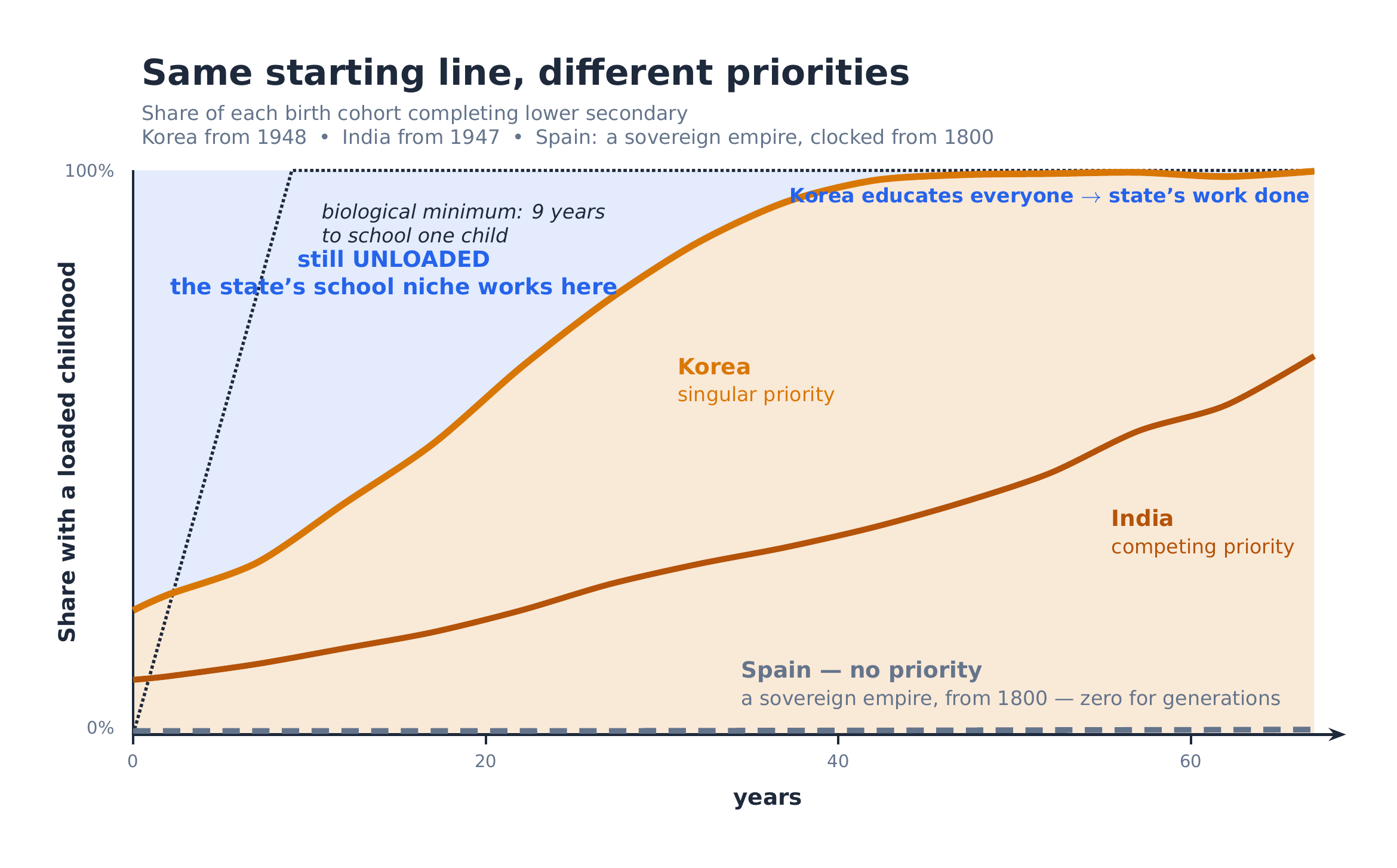
The same window, loaded at different speeds. Under singular priority Korea reaches near-universal lower-secondary completion within a generation; under competing priorities India climbs slowly; Spain, a sovereign power that did not prioritise, sits at zero across the nineteenth century. The state sets only the pace.
The human baseline — the state before formal education reaches a population — is high fertility, high child mortality, low life expectancy, hunger, and disease. This is not a description of poverty. It is a description of the species before the one intervention that changes all of them simultaneously. Development means people live long lives and women have fewer children.
I measure it concretely: life expectancy above 69.8 years and fewer than 3.65 children per woman — the 1960 United States values. I take the Human Development Index as my inspiration: education, both means and end — but I measure development by what it delivers, long lives and chosen family size. A TFR below 3.65 is itself an achievement: in 1960, only the developed world — roughly a quarter of humanity — had fertility that low. The remaining three-quarters averaged a TFR above 6 — the human baseline. These are not a narrow substitution for a richer conception of development. They are the two most direct population-level expressions of whether the cognitive transformation produced by education has occurred. Life expectancy tracks whether people have the planning horizon, health knowledge, and behavioural capacity to sustain their own survival. Fertility tracks whether women have moved from biological fate to conscious reproductive choice. These metrics measure the generative condition from which richer development becomes possible. The measure of education is lower secondary completion — finishing roughly nine years of schooling.
The mechanism
Humans take roughly eighteen years to reach adult competence. That is not a deficiency. It is the mechanism. Eighteen years of sustained dependency place a dedicated learner inside a niche of dedicated teachers — parents, grandparents, older siblings, near-kin — for nearly two decades. Long enough for cumulative cultural knowledge to be absorbed so deeply that it becomes the learner's own baseline. The learner then becomes a teacher in the next generation's niche. The cycle repeats every generation. What travels through this channel is cultural, not genetic. But the channel itself is biological. It requires the species-specific juvenile dependency period that only humans possess.
This is the home niche: the set of near-older humans embedded in a child's daily life across the dependency window. Parents are central, but grandparents, older siblings, and near-kin all carry it forward. The home niche fires with biological certainty. It transmits not just knowledge but norms, aspirations, health behaviours, and the decision to send the next child to school. It runs on self-interest: parents invest in their own children without requiring ideology, altruism, or institutional commitment to sustain the behaviour. The grandchild's attainment reflects the grandparent's through two sequential cycles. The great-grandchild's through three. The channel is built into the species.
Of everything the home niche transmits, one item is operative: the decision to educate the next child. A parent who completed school sends their child to school — with expectation, monitoring, and reinforcement. A parent who did not, does not — or does so without any of these. Completion transmits as a norm. The completion threshold is the gate; what happens after the gate is dose-response. The educated parent's role is not to teach their child what they learned in school. It is to hold the expectation that their child belongs in school — to see completion as normal, to monitor attendance, to assume that the educated world is where their child will live. An uneducated parent cannot open this gate, because they have no experience of the world on the other side.
The educated household member — parent or older sibling — is not one transmission channel among many. They are the switch that activates all the others. Sending a child to school places that child in reach of teachers, textbooks, peers, and every institution the educated world has built. Without the decision, none of these fire. In many households it is the first sibling to complete school who flips the switch — tutoring younger children, setting expectations, demonstrating that completion is normal. Extended families, communities, and diasporas amplify the signal. But the first educated member of a household is the node through which every other channel reaches the next generation.
The payload
Formal schooling is the most powerful payload ever delivered through this channel. The neuroscience is unambiguous: literacy physically restructures the brain's visual processing pathways; numeracy activates brain regions that remain dormant in people who never learn to count. These are not marginal improvements on existing capacities. They are new cognitive technologies that do not develop without schooling, regardless of intelligence or environment. What schooling installs is a stack of categorical jumps — germ theory, atoms, evolution, the natural numbers extending without bound — each a kind-flip with no halfway position; more years of schooling means more jumps, composed onto the rungs already in place.
Most populations through history were poorly nourished. Literacy worked anyway. The neural substrate that learning requires evolved over two million years of human dependency; contemporary nutrition affects the ceiling of performance and the speed of acquisition (Grantham-McGregor et al. 2007), not the substrate itself. Fixing nutrition first was never available to them — that takes money, and money is what educated populations produce, not what they wait for. The distance from no formal education to any formal education is categorical. The distance from a bad school to a great school is marginal by comparison.
The dose is duration of exposure, not fidelity of instruction. What formal schooling provides is sustained immersion in literate culture: structured time, abstract categorisation, written language, numeracy, adult authority organised around knowledge transmission. The longer the child remains inside this environment, the deeper the cognitive reorganisation. A child who completed nine years of poor-quality schooling and scored badly on every assessment has still spent nine years inside an environment that reorganised their cognition categorically relative to a parent who never entered the building.
Tested directly: it is the years a population completes — not the test scores of today's pupils — that predict the development outcomes. The relationship is continuous: completion at every level moves them, with nearly the same slope per year, and lower-secondary completion is the single strongest predictor of the outcomes. What test-score quality there is is best predicted not by today's schools but by the parent generation's completion a generation earlier. Today's measured quality is yesterday's quantity, compounded through the household. Time in school, generation by generation, does the work.
Content does not matter for the mechanism. A software engineer does not remember 10th-grade biology. A doctor does not remember trigonometry. Decades later, the specific material is gone. If the mechanism operated through content, education would depreciate as content is forgotten. It does not. The gains persist because they run through something that content exposure produced but that survives the content's disappearance: the cumulative cognitive reorganisation. Years of sustained exposure across biology, chemistry, history, mathematics, and literature do not produce adults who remember all five. They produce adults whose cognition was reorganised by years inside five different formal knowledge systems. The content is the vehicle; the reorganisation is the payload. The vehicle is disposable. The payload is permanent.
The home niche operates on this threshold. The household decision to send a daughter to school, to space births, to recognise symptoms, to vaccinate a child — these are the decisions of educated adults exercising agency across a lifetime. The generational lag between educational investment and development outcomes is not a statistical accident. It is the interval for educated children to become adults and begin making these decisions. States can create conditions for these decisions. They cannot make them.
The pathway
The mechanism that lifts a population off the human baseline runs as a cycle:
Education → cognitive restructuring → intent restructuring → fertility transition → resource release per child → home-niche uplift → next generation's education → repeat.
Education restructures how people think. Changed cognition restructures what people want and what they believe is possible — family size becomes a choice, child survival becomes an expectation, investment in each child becomes feasible. Fertility falls. Fewer children means more resources per child. Those resources lift the home niche of the next generation: each cohort's schooled young adults become the near-adults the next cohort grows up among, and the cycle repeats. Each pass clicks the ratchet. The entire development trajectory — from high-TFR, low-LE societies to low-TFR, high-LE societies — is this cycle running across generations.
The pace is set by demographic metabolism (Lutz 2013): a country's educational mix shifts only as fast as new, more-schooled cohorts displace older, less-schooled ones. This is the biological speed limit on every national educational expansion — and why the fastest transitions in the historical record still take a generation.
Irreversibility
The home niche explains why educational gains never reverse. No generation in any country's trajectory has completed school at a lower rate than its parents. The gains are irreversible because they are embodied in people, not stored in budgets or institutions. Income can be removed by economic crisis. Government services can be removed by fiscal collapse. Both happen routinely. Education cannot be removed because it lives in the educated adult, not the institution. Even the Khmer Rouge did not reverse Cambodia's education level. Each generation's completion remained above its parents'.
This is new in the species' history. For ten thousand years complex societies rose and ran back — the Bronze Age palace economies, Rome into the loss of Latin literacy, the Maya. A literate elite could build great complexity on an illiterate population, but when crisis came the literate class and the knowledge it carried were lost with it, and the complexity collapsed. What the spread of schooling to a whole population changes is not that complexity becomes possible but that it becomes irreversible: knowledge carried by an entire literate population cannot be lost with an elite. This is the first arrangement in human history whose gains hold.
Tests predict that education should depreciate — content is forgotten, scores would decline if re-tested, specific knowledge fades. Education does not depreciate. Therefore what persists is not what tests measure. It is the cognitive reorganisation that years of content exposure produced. The vehicle is gone. The payload remains.
Why education is invisible
An educated person is physically indistinguishable from an uneducated one. Wealth builds visible infrastructure; disease marks the body; education rewires cognition and leaves no trace on the surface. The only observable signal is behavioural change — and we misread it. We see smaller families and call it contraceptive access. We see longer lives and call it health systems. We see rising productivity and call it economic growth. Every discipline theorises the downstream behaviour without tracing it back to the cognitive reorganisation that produced it. Education has no physical signature, so the signature it does leave — changed decisions, across every domain, for the rest of the person's life — is assigned to whatever domain notices it first.
The very act of ranking priorities is an educated act. This is the central reason education has been misclassified for so long. Educated people consistently rate education as important — one of many important things, ranked alongside health, nutrition, governance, and security. They cannot categorise it as fundamental, because that would require seeing their own cognition from outside — recognising that the capacity to evaluate, compare, and advocate is itself the product of education.
The people who could identify education as fundamental are inside it. The people who would benefit most from it are outside it. For the uneducated household, the cost of schooling is immediate and concrete — a child not working, fees, uniforms — while the return is abstract, delayed by a generation, and has no precedent in the household's own experience.
The transformation is not merely invisible; it is unimaginable, because the cognitive frame required to evaluate it is the product of the education they lack. Neither group can see what education is, and for opposite reasons: one because it is invisible from within, the other because its absence is invisible from without. This is why the field of development economics — staffed entirely by educated people — has consistently classified education as one input among many. The framework builders are inside the mechanism. The policy frameworks they produce reflect that blindness.
The dilution has a mechanism. Education simultaneously widens who you invest in (literacy connects you to people you have never met; shared knowledge expands the boundary of identity from kin to nation to humanity) and creates surplus to invest (fewer children, nearly all surviving, freeing time and resources a parent with seven children and three surviving does not have). Neither alone is sufficient: surplus without expanded identity stays in the family; expanded identity without surplus is talk with no resources behind it. Education produces both, and the combination disperses investment across every good cause simultaneously — health, nutrition, governance, security, and education all competing for the same pool. This is not a failure of educated people. It is the structure of educated behaviour.
The critical distinction is durability, and the axis that predicts it is motivational, not geographic. The home niche compounds because it runs on self-interest: the parent invests in the child in front of them. Every non-education intervention — whether delivered by a village health worker or a distant aid programme — requires someone to keep serving past the point where self-interest would redirect them. Revolutionary commitment, donor altruism, state fiscal discipline: all are fragile because all run against the grain of normal human motivation. Education runs with it. Non-education intervention buys time; educational investment changes trajectory.
The result is a discipline that treats education as one input among many — weighted, traded off, sometimes deprioritised in favour of interventions with faster measurable returns. The framework never asks whether the capacity to design, evaluate, and sustain those competing programmes is itself a product of education. It cannot ask, because the question would dissolve the framework.
This applies to the frameworks through which this paper will be evaluated. Development as multivariate, education as one input among many — these are themselves products of the mechanism the paper describes. The capacity to rank, compare, and weigh competing inputs is itself a product of education. The thing you will use to evaluate this paper is the thing this paper is about.
The historical exceptions confirm the rule. In every case where the decisive commitment was made, the motivation came from outside the development frame entirely: John Knox from religious conviction, Meiji Japan from existential military threat, Korea from Cold War survival. What these actors shared was not superior analysis but an external compulsion strong enough to override the default — the default being the educated person's inability to see education as anything other than one priority among many. Knox did not weigh education against healthcare. He saw universal literacy as a religious obligation that admitted no trade-off. The Meiji oligarchs did not run a cost-benefit analysis. They saw an existential threat that demanded the entire population be educated, immediately, regardless of cost. Korea's Park Chung-hee saw a country that would be absorbed unless it educated its way to survival within a generation.
The development frame has never produced this decision. The frame produces trade-offs. The decision requires refusing to trade off.
The Country Histories
By 2022, 154 countries representing 80% of the world's population have crossed both thresholds. Every one through education. The variation is only in speed.
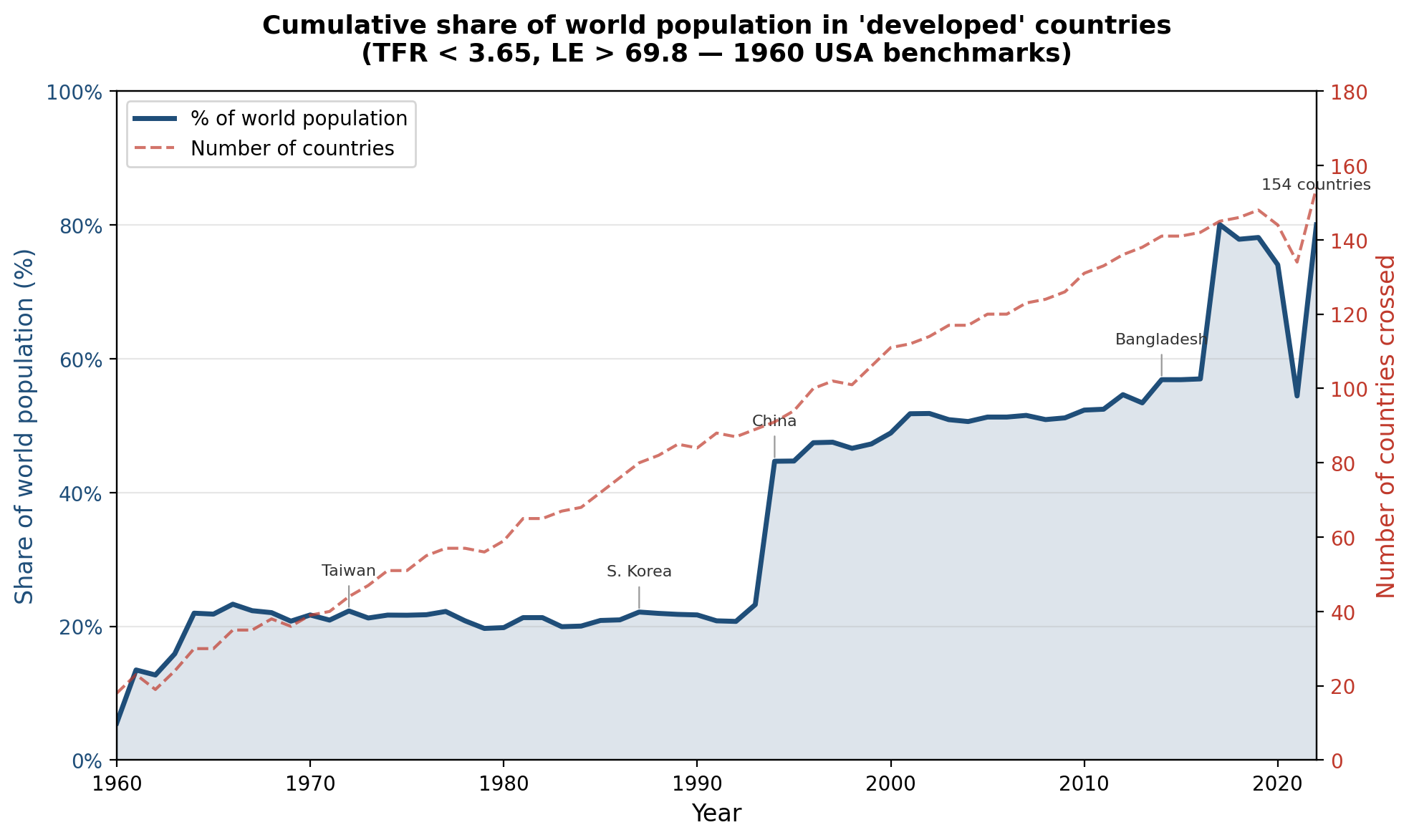
Cumulative share of world population crossing both development thresholds, 1960–2022. (Source: World Bank WDI, WCDE v3.)
The curve accelerates after 1990 — the generation educated in the 1960s–70s post-colonial expansions reaching adulthood. The remaining 20% is concentrated in sub-Saharan Africa, with Pakistan, Afghanistan, and Yemen as the largest exceptions outside the continent.
| Country | Developed | Fertility | Life exp. | Expansion onset | Lag |
|---|---|---|---|---|---|
| Taiwan | 1970 | 1970 | 1970 | 1950s | 20 yrs |
| S. Korea | 1987 | 1975 | 1987 | 1953–65 | 25 yrs |
| Cuba | 1974 | 1972 | 1974 | 1961 (40% base) | 13 yrs |
| Bangladesh | 2014 | 1995 | 2014 | 1990s | 24 yrs |
| Sri Lanka | 1993 | 1981 | 1993 | 1940s–50s | 42 yrs |
| China | 1994 | 1975 | 1994 | 1950s+Cultural Rev. | 42 yrs |
| India | 2017 | 1996 | 2017 | 1950s | 67 yrs |
| Uganda | — | 4.39 | 67.7 | None | — |
Korea: 35 years. In 1950 the Philippines was ahead of Korea on income per capita, on lower-secondary completion (22% vs 18%), and on colonial educational inheritance. By 2000 Korea had crossed every development threshold; the Philippines had crossed none. The educational regime flipped the rank order. Korea was one of the poorest countries in the world in 1953. GDP per capita of $1,038 in 1960 (constant 2015 USD). Made education the unconditional national priority. Expanded lower secondary completion from 25% to near-universal in 35 years — 7 to 14 percentage points per five-year period during the main expansion (1955–1980), sustained without interruption. Fertility fell and life expectancy rose before Korea was rich. The mechanism did not wait for income. By the time income arrived, the educated population converted it into one of the world's largest economies. As completion approached 90%, each new generation gained less over its parents — not because the mechanism weakened, but because nearly everyone was already educated. The pattern is the signature of state investment amplifying what households transmit.
Bangladesh: $1,159. The most important case in the table. Lower secondary completion was 11.4% in 1960. GDP per capita was $1,159 in 2014 when it crossed both development thresholds. The premise that income is the prerequisite for development is directly refuted. Bangladesh made the decision to treat girls' education as the primary investment from the 1990s onward. The gender gap in children's completion collapsed. Fertility decline tracked girls' secondary expansion, not contraceptive distribution. The life expectancy and fertility gains came through educated household decisions — the same household decisions visible in every case in this table. Bangladesh's children are completing school at rates far higher than their parents' education alone would explain — 15.8 percentage points higher. That gap is the sustained expansion. The 2014 crossing was its result, 24 years later. Income is not the mechanism.
Cambodia: the home-niche shadow. Cambodia shows what happens when education is destroyed — and how long the damage lasts. Under the Khmer Rouge (1975–1979), the education system collapsed. Lower secondary completion was 10.1% in 1975. It fell to 9.4% by 1980 and was still at 9.5% in 1985 — a full decade of zero progress while the rest of the world advanced. After reconstruction, completion jumped to 35% by 1995. Then it stalled again. From 1995 to 2010, completion plateaued at 31–36% despite continued international investment. The buildings were there. The teachers were there. The money was there. Progress did not come.
International money rebuilt the school niche and pushed completion to 35% — well above the parents' 10%. But it stalled there. The home niche had been gutted of literate adults, and a school niche on its own does not lift a generation whose home niche carries no literate cultural transmission to absorb it with.
The children reaching secondary school in 1996–2010 were born 1982–1996 — their parents were the cohort whose education was frozen at 10% during 1975–1985. Recovery began only after 2011, when the post-disruption cohort's children entered the system. The twenty-year gap between the buildings coming back (1991) and progress resuming (2011) is the home-niche shadow — the delay caused by the frozen parental baseline.
Countries that started at Cambodia's level in 1960 reached a median of 46% by 2015. Cambodia reached 36%. The gap is one generation of stalled parental education, expressing itself in the educational attainment of the next.
Spain: 450 years of wealth without development. The richest empire on earth for two hundred years. Spain controlled more gold and silver than any nation in history. It did not develop until it finally educated its people in the late twentieth century. Wealth was never the mechanism. Britain took centuries. The United States and Japan each took about a century. Korea did it in 35 years. The variable is not wealth. It is the decision to educate.
China: the largest educational expansion in history. Three corrections to the standard narrative. First, the standard account credits the one-child policy with China's fertility decline. The data show the threshold was crossed in 1975 — five years before the policy began. The most famous population policy in human history was unnecessary for this threshold: fertility had already crossed the 3.65 line five years before coercion began. Second, the standard account treats the Cultural Revolution as an educational catastrophe. It disrupted universities and urban elites. But for rural China — the vast majority of the population — community schools brought secondary education to villages that had none. It was in fact the largest lower secondary expansion in China's education record. Rural China — 80% of the population — got educated while the universities were disrupted.
Third, the standard account credits barefoot doctors with China's health gains. The barefoot doctors and the community school teachers came from the same Cultural Revolution-era rural mobilisation. The doctors were local, culturally embedded, drawn from the villages they served — optimally delivered provision. When Deng dismantled the system after 1980, they left, because rational people freed from revolutionary ideology redirected their labour toward self-interest. Life expectancy continued to rise — from approximately 64 to 69.8 by 1994 — because the educational baseline built into rural households did not leave with the doctors.
The Evidence
The proof is biological. What humans are — the long childhood, the home niche that fills it, the payload schooling loads into it — is the cause, and the first part of this essay laid it out. What follows does not replace that proof; it confirms it: across every country at once, at the extreme where famine tests it, and at the thresholds that fix how much schooling, and for how long. No specialised training is required to read it. Every number is traceable to a script that produces it from source data; the verifier published with the paper makes the empirical argument equally checkable for the reader and the author.
The claim is testable, and I test it directly. If education is fundamental, then once education's contribution is removed from income, income should have nothing left to predict.
Here is the test. Take each country's income and remove the part that education produced. Use only what remains to predict how long people live, how many children they have, and whether the next generation goes to school. If income matters on its own, it should still predict something. The test covers 144 countries, comparing each country only to its own past, with education data spanning 140 years.
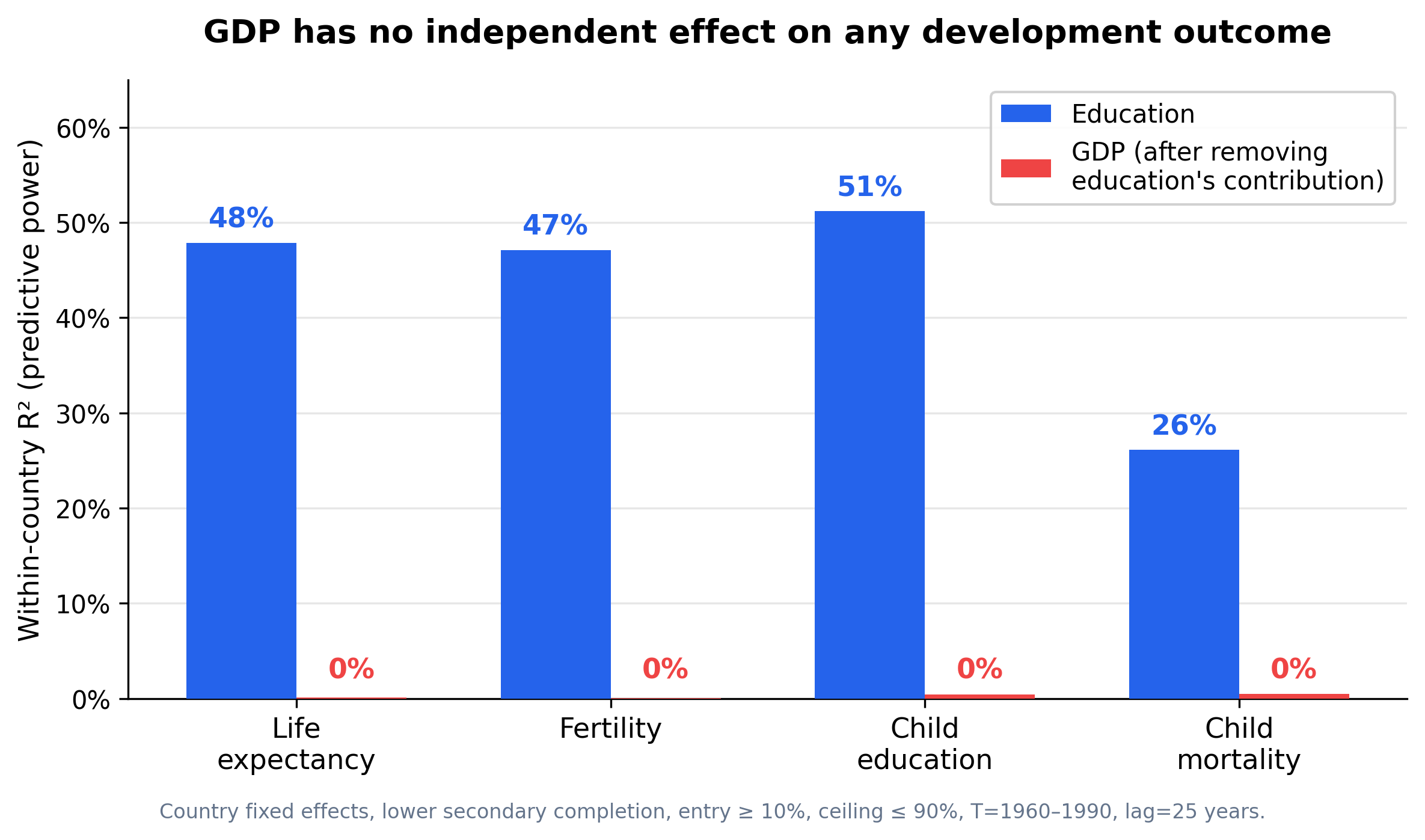
Education's predictive power (blue) vs. income's predictive power after removing education's contribution (red), across four development outcomes one generation forward. (Source: author's calculation, World Bank WDI and WCDE v3.)
Knowing only how educated a country's parents were, you can explain roughly half of how long their children will live and how many children they will have — one generation later. After removing education's contribution to income, I find income explains under 2% of variance on every development outcome tested. Income's remaining predictive power is 0.2% for life expectancy, 0.0% for fertility, 0.5% for the next generation's education, and 0.1% for child survival. Enter both regressors together in a within-country fit and the asymmetry sharpens further: education's unique contribution beyond income is 25–39% of within-country variance across the four outcomes; income's unique contribution beyond education is at most 0.7% and rounds to zero on fertility. Backfilling pre-1990 income with Maddison historical data expands the sample by 14% and leaves the asymmetry intact. Walking the entry-cohort ceiling from 20% to 90% locates where income retains any signal: only on the next generation's education itself, in the active-expansion window (parental completion 40–80%), where income explains an additional 1–2% of within-country variance — one to two orders of magnitude smaller than education's contribution on the same sample, and the same order as Lutz and Kebede (2018) find for international child health interventions on child mortality. Income mattered only because education was flowing through it. The result replicates on an entirely separate education dataset — years of schooling instead of completion rates — with income's leftover power on life expectancy still below 0.3%.
Education explains 42% of how each country's income changes over time. The remaining 58% — the majority — predicts no development outcome tested.
Education's reach spans four generations. Income's collapses in one. A great-great-grandparent's school completion predicts their great-great-grandchild's child-survival outcomes a century later. The signal fades slowly: 66% at the same time, 67% one generation forward, 44% two generations forward, 25% three generations out, still 16% four generations out — the only outcome where education still explains more than 15% of within-country variance after a century of intervening households. Beyond two generations, income differences across countries were too small to predict anything.
Famine makes the claim extreme. Of 21 major famines since 1950, 19 occurred where fewer than half of young adults had completed lower secondary school. The two exceptions required external force — a totalitarian state in one case, a naval blockade in the other — to physically prevent educated populations from reaching food. In 1966 a national drought crashed India's grain production by 19%. Bihar, 22% literate, suffered a famine that killed 70{,}000 to 130{,}000 people. Kerala, 55% literate and 40% dependent on imported food, did not. Same country, same constitution, same free press. Educated populations do not starve. They reorganise supply, ration, substitute, and demand response. Uneducated populations cannot.
The claim is operational, not slogan. In the seventy-three non-oil countries that have crossed both demographic thresholds, none did so with lower-secondary completion below thirty-five percent in the young-adult cohort. A country that lands both thresholds with completion below thirty-five percent breaks the necessity claim. And in the countries that expanded at one and a quarter percentage points per year or more from below ten percent, with no disruption to the channel, the joint crossing arrived within thirty years of passing the thirty-five percent floor: Cuba sixteen, China twenty-six, Korea thirty, Indonesia thirty-three. A country meeting both conditions that does not cross within thirty years breaks the sufficiency claim. The thresholds are not curve-fits. They are the shape of every joint crossing in the historical record.
Full methodology, robustness checks, and subsample analyses are in the companion paper, The Long Childhood: On the Convergence of Humanity.
The Decision
I close with the decision the evidence forces.
What the evidence shows
No country has developed without education. No country with sustained educational expansion has failed to develop. The remaining 20% is concentrated in sub-Saharan Africa. These populations are not facing an untested proposition. They are facing a mechanism that has already delivered for four-fifths of the world.
Sufficiency follows from the mechanism, not just from the data. Income stripped of education's contribution explains under 2% of any development outcome; once both are entered jointly, income's unique contribution tops out at 0.7%, against education's 25–39%. Provision without educated populations produces no durable outcomes. Institutions are built by educated populations, not the reverse. Every input previously thought necessary for development is either produced by education or irrelevant to it. Education is not the most important input. It is the only input. Everything else is either its product or noise.
This is structural, not just measured. Education is the only intervention that loads the cognitive substrate during the 18-year juvenile dependency window. Every other policy lever acts on adults already formed. No other variable has, or can have, this influence. The Human Development Index, in 1990, registered this without naming it: of every candidate Haq and Sen could have placed alongside life expectancy and income, they chose education.
The question is not whether development will arrive through income growth or state provision. That debate describes how resources flow through different institutional channels — markets or state services — not the underlying cause. Where educational expansion is fast and markets function, income growth becomes visible and gets credited. Where expansion is slow and markets are absent, state services are the only observable welfare activity and they get credited instead. Both are downstream of education. The framework that dominates development policy describes surface appearances, not causes.
The historical record maps onto three speeds. The mechanism is the same; only the speed varies. Singular priority: the state makes education the unconditional national focus. Near-universal completion in roughly 35 years. Korea, Taiwan, Cuba (Cuba's higher starting base shortened the timeline to 13 years). Competing priority: education competes with health, nutrition, security, and governance for funding and political attention. 50–75 years. India and most post-colonial countries. No priority: the state does not invest. Pre-industrial, this produced stasis; post-industrial, educated minorities with surplus and widened identity slowly expanded access through religious and community channels. Britain and the Netherlands took 150–200 years to reach universal completion.
None of these required high income. Korea began its expansion at $1,038 per capita. Bangladesh crossed at $1,159. Nepal crossed in 2022 at $1,114 — the lowest income at which any country has crossed both thresholds — with children completing school 17.8 percentage points above what their parents' education alone would explain. The mechanism does not care about regime type, ideology, or income level. Korea and Taiwan (authoritarian), Bangladesh and Nepal (democracy), Cuba (socialism) crossed under different regime types and some of the poorest economies on earth. The mechanism cares whether the decision is made.
The mirror of the speed table is the cost of countries that did not run the demonstrated pace from the years when the demonstration was already in. Had every developing country adopted Korea's empirical 2.13 percentage-points-per-year pace from 1990 forward, beyond what actual education in fact delivered, one hundred four million more lives would have been saved through 2025—thirty-eight million through educated mothers' children surviving at higher rates, sixty-seven million through educated mothers having fewer children to begin with. From 1980 forward the floor is one hundred eighty-eight million; from 1970, two hundred eighty-four million. These are floors. The 2025 horizon truncates roughly four-fifths of the predicted effect from a 1990 anchor; most materialises between 2025 and 2050.
What the decision requires
The decision is sustained state commitment to expand education — particularly girls' education — as the primary national objective, maintained across political cycles and competing priorities.
This is not a new ask. In 2015 every government on earth signed Sustainable Development Goal 4: ensure that all girls and boys complete free, equitable and quality primary and secondary education leading to relevant and effective learning outcomes. The decision is not to invent a target. It is to deliver the one already signed — full secondary education, free, measured by learning, not enrolment.
The household mechanism that drives fertility decline, child survival, and the next generation's schooling runs through mothers. Girls' education is the highest-return lever in the entire system. In the companion paper's analysis, lower secondary completion is the strongest predictor of every development outcome tested. The relationship is continuous — completion at every level moves the outcomes, with no grade at which a switch flips — and the outcomes differ from one another not by which grade drives them but by how long each takes to show. Fertility moves first, within a few years of a cohort finishing school, as those women bear fewer children than their mothers did. Life expectancy and child survival follow a generation later, once the children they bear have lived through the early years. The hardest place to start is the bottom: where completion is lowest, population growth is fastest, and the gains from each educated group are spread across a larger and faster-growing next generation. Sustained state investment is required all the way to near-universal completion. Korea's data show steady expansion from 25% to over 90% with no inflection at any point. Fertility decline is the first expression of women's empowerment, not a proxy for it. The shift from the norm of large families to conscious choice rises continuously with women's schooling, with no single grade at which it switches on. The further dimensions — labour force participation, bargaining power, political voice — follow after fertility falls.
Once made, the gains are irreversible — embodied in people, not stored in budgets — and visible within a single political term: completion rates rise within 5–10 years of sustained investment, providing the metric a leader needs before the generational returns arrive.
The 154 countries that have already crossed took between 13 and 450 years. Spain was the richest empire on earth for two hundred years and took 450 to develop; Cuba made the education decision and crossed in 13. The variation is explained entirely by when the decision was made and whether it was sustained.
Korea expanded lower-secondary completion at two percentage points per year — the fastest sustained pace in the historical record. Korea passed 35% completion (the threshold below which no country has ever made the joint crossing) in 1957 and crossed both demographic thresholds in 1987: thirty years from floor to crossing, one generation. At half Korea's pace, the wait spreads to two generations; at a third, three.
Most remaining countries start with higher education baselines than Korea had in 1953 and cross sooner for that reason — Cuba did, having entered the 1961 campaign already near 40% completion, well above the floor. The decision-to-crossing horizon is shorter for them, not longer. The mechanism is not a theory. It has already delivered for four-fifths of the world.
The remaining fifth is not waiting for income, institutions, or provision. It is waiting for the decision. The cohort whose adulthood will produce the next convergence is in school this year — or it is not. The window admits exactly what is loaded into it, and it closes one cohort at a time.
This is the state's decision, because only the state can reach the first generation — the children whose parents were never schooled, who cannot load a literate home from a home that carries none. But the leader is not the only one who decides. Every person the schools already reached can hold the same discipline a state holds: education as the one cause, ahead of all the others. The parent who loads her own child does it without deciding. The decision that stays open is for the children who are not hers — the ones the pace has not yet reached. The leader sets the pace for a nation's children; everyone already educated decides what becomes of the child the pace has not reached.
The decision is necessary.